 +91 9380344310
 nervecareofficial@gmail.com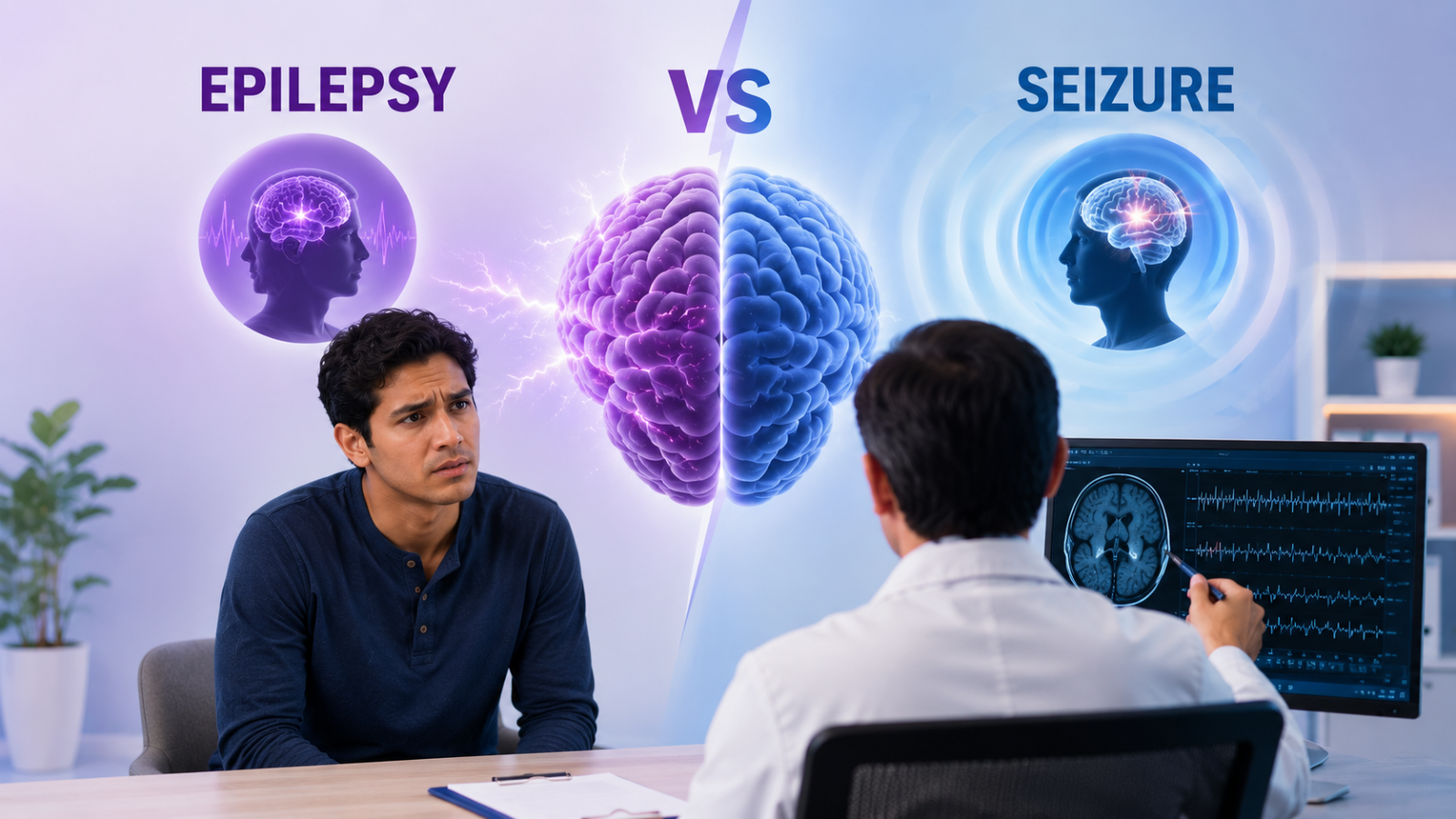
Written by Dr. Chakradhar Reddy N, MBBS, DM Neurology — Consultant Neurologist & Parkinson's and Movement Disorder Specialist, Nerve Care Clinic, Puppalaguda, Hyderabad
Experiencing a seizure — or watching a family member have one — is one of the most frightening neurological events that brings families to Nerve Care Clinic. The urgency is understandable. But the fear is often intensified by a misunderstanding: many people believe that having a seizure automatically means they have epilepsy. It does not.
Understanding the distinction between a seizure and epilepsy matters because it shapes the entire treatment approach. Not every seizure requires long-term medication. Not every seizure will recur. The neurologist's job after a first seizure is to determine: what caused this, how likely is it to happen again, and what — if anything — should be done about it.
What Is a Seizure?
A seizure is an episode of abnormal electrical activity in the brain. The electrical system of the brain normally operates in coordinated, controlled patterns. In a seizure, a group of neurons fires abnormally and excessively — either in one area of the brain (focal seizure) or across the brain simultaneously (generalised seizure). The clinical manifestation depends on which brain area is involved.
Seizures can cause: convulsions (the dramatic jerking movements that most people associate with the word 'seizure'), staring episodes or absence (brief lapses of consciousness that look like blanking out), focal jerking of one limb or one side of the face, unusual sensations (tingling, visual disturbances, a rising sensation in the stomach), or altered awareness without convulsion.
A seizure is a symptom — not a diagnosis. It is a sign that something has disturbed the brain's electrical activity. That disturbance can be temporary (a high fever in a child, low blood sugar, alcohol withdrawal, a medication) or structural (a brain lesion, scar tissue from old injury). A single seizure has many possible causes, most of which do not recur.
What Is Epilepsy?
Epilepsy is a brain disorder defined by a predisposition to generate recurrent seizures. The standard clinical definition of epilepsy is met when a person has:
- Two or more unprovoked seizures occurring more than 24 hours apart, OR
- One unprovoked seizure AND a probability of further seizures greater than 60% (based on imaging findings, EEG findings, or a specific epilepsy syndrome), OR
- A diagnosis of a specific epilepsy syndrome based on clinical and test findings
'Unprovoked' is the key word. A seizure that occurs because of a direct brain insult — a fever (in children, febrile seizures), acute low blood sugar, alcohol withdrawal, a brain infection — is a provoked seizure. Provoked seizures are treated by addressing the cause, not by starting antiepileptic medication. They do not, by themselves, indicate epilepsy.
Types of Seizures — What Witnesses Often Describe
Generalised tonic-clonic seizure (the most recognised type)
The person suddenly loses consciousness, falls, body stiffens (tonic phase), then the limbs begin rhythmic jerking (clonic phase). There may be a cry at onset (from air being forced through the vocal cords), tongue biting, urinary incontinence, and frothing at the mouth. The seizure typically lasts 1–3 minutes, followed by a post-ictal phase — the person is confused, exhausted, and difficult to rouse for 10–30 minutes or longer.
Absence seizure
Brief (5–30 second) lapses of consciousness with staring and cessation of activity. The person appears to 'zone out' and does not respond. There is no falling, no convulsion. They resume normal activity immediately after, often without awareness that the absence occurred. Very common in childhood epilepsy syndromes.
Focal aware seizure
The person remains conscious but experiences abnormal sensations, movements, or emotions arising from one area of the brain. A rising feeling in the stomach, a smell that isn't there, automatic hand movements, déjà vu, or tingling in one hand are all possible focal aware seizure manifestations. These were formerly called 'partial seizures'.
Focal to bilateral seizure
A focal seizure that spreads across the brain and evolves into a generalised tonic-clonic seizure. Witnesses often see a brief focal phase (one hand shaking, head turning to one side) before the full convulsion begins.
First Aid During a Seizure — What Families Must Know
⚠ During a convulsive seizure: DO NOT restrain the person. DO NOT put anything in their mouth. DO position them on their side (recovery position) to protect the airway. DO time the seizure. DO call emergency services if the seizure lasts more than 5 minutes or if a second seizure begins before the person has recovered from the first.
A seizure that lasts more than 5 minutes (status epilepticus) is a medical emergency requiring immediate hospital treatment.
What Happens at a First Neurology Appointment After a Seizure
The first neurology appointment after a seizure has one primary goal: determine what caused it and whether it will happen again. Here is what the assessment involves:
History — the most important part
I take a detailed history of the event — not just from the patient (who may have no memory of the seizure itself) but from whoever witnessed it. The description of what happened before, during, and after the seizure is the most diagnostically valuable information available. I ask about: was there a warning (aura)? Did one part of the body move first? Was consciousness lost? How long did it last? What was the person doing just before? Were they unwell, sleep-deprived, had they been drinking? Have there been any prior unexplained episodes that may have been unrecognised seizures?
EEG (Electroencephalogram)
An EEG records electrical activity in the brain through electrodes placed on the scalp. It is painless and takes 30–40 minutes. An EEG can show epileptiform discharges — abnormal electrical patterns that suggest seizure predisposition — even between seizures. A normal EEG does not exclude epilepsy (up to 50% of people with epilepsy have normal interictal EEG), but an abnormal EEG significantly informs treatment decisions.
MRI brain
MRI is recommended after a first unprovoked seizure in most adults to exclude structural causes — a brain tumour, an area of cortical dysplasia, an old ischaemic lesion, hippocampal sclerosis. MRI is significantly more sensitive than CT for these findings. A normal MRI is reassuring but does not exclude a genetic epilepsy syndrome.
Blood tests
Sodium, glucose, calcium, kidney and liver function, and a full blood count are checked to exclude metabolic causes of provoked seizure. In specific situations, an ECG is done to exclude a cardiac cause of loss of consciousness that may be mimicking a seizure.
The Treatment Decision — When to Start Medication
Whether to start antiepileptic medication after a first seizure is not automatic. The decision depends on the recurrence risk — which is determined by the EEG findings, MRI findings, seizure type, and clinical circumstances. Patients with a clearly abnormal EEG or a structural brain lesion are at significantly higher recurrence risk and are usually started on medication. Patients with a normal EEG, normal MRI, and a clear provoking factor (sleep deprivation, alcohol, fever) may be monitored without medication.
When medication is started, the choice of antiepileptic drug (AED) depends on the seizure type and epilepsy syndrome — different drugs are effective for different types. Sodium valproate, lamotrigine, levetiracetam, carbamazepine, and several others are used based on the specific clinical picture and the patient's profile. Most people with epilepsy achieve good seizure control with one appropriately chosen medication.
Book a consultation at Nerve Care Clinic, Puppalaguda — call or WhatsApp +91 9380344310. Evening OPD Monday to Saturday, 6:00 PM to 9:00 PM.
Frequently Asked Questions
1. If I have one seizure, do I need to be on medication for life?
Not necessarily. The decision to start medication is based on recurrence risk, not the fact that a seizure occurred. Many patients with a single provoked seizure require no medication. Patients who are started on medication after unprovoked seizures typically continue for a minimum of 2 years seizure-free before consideration of gradual tapering.
2. Can I drive after a seizure?
In India, people with active epilepsy are not permitted to hold a driving licence. After a first seizure, most neurologists advise against driving for a period — typically 6–12 months, or until the recurrence risk has been fully assessed and the condition is under control. Discuss this specifically with your neurologist, as the guidance depends on your individual situation.
3. Is epilepsy hereditary?
Some epilepsy syndromes have a genetic basis and run in families. Many do not. The genetic risk to children of a parent with epilepsy depends entirely on the type of epilepsy — for most acquired epilepsies (from brain injury, stroke, or infection), the genetic risk to offspring is minimal.
4. Does epilepsy go away on its own?
Some childhood epilepsy syndromes (such as childhood absence epilepsy and benign rolandic epilepsy) do remit spontaneously in adolescence. Adult-onset epilepsies generally require long-term management. Approximately 70% of people with epilepsy achieve seizure freedom with appropriate medication.