 +91 9380344310
 nervecareofficial@gmail.com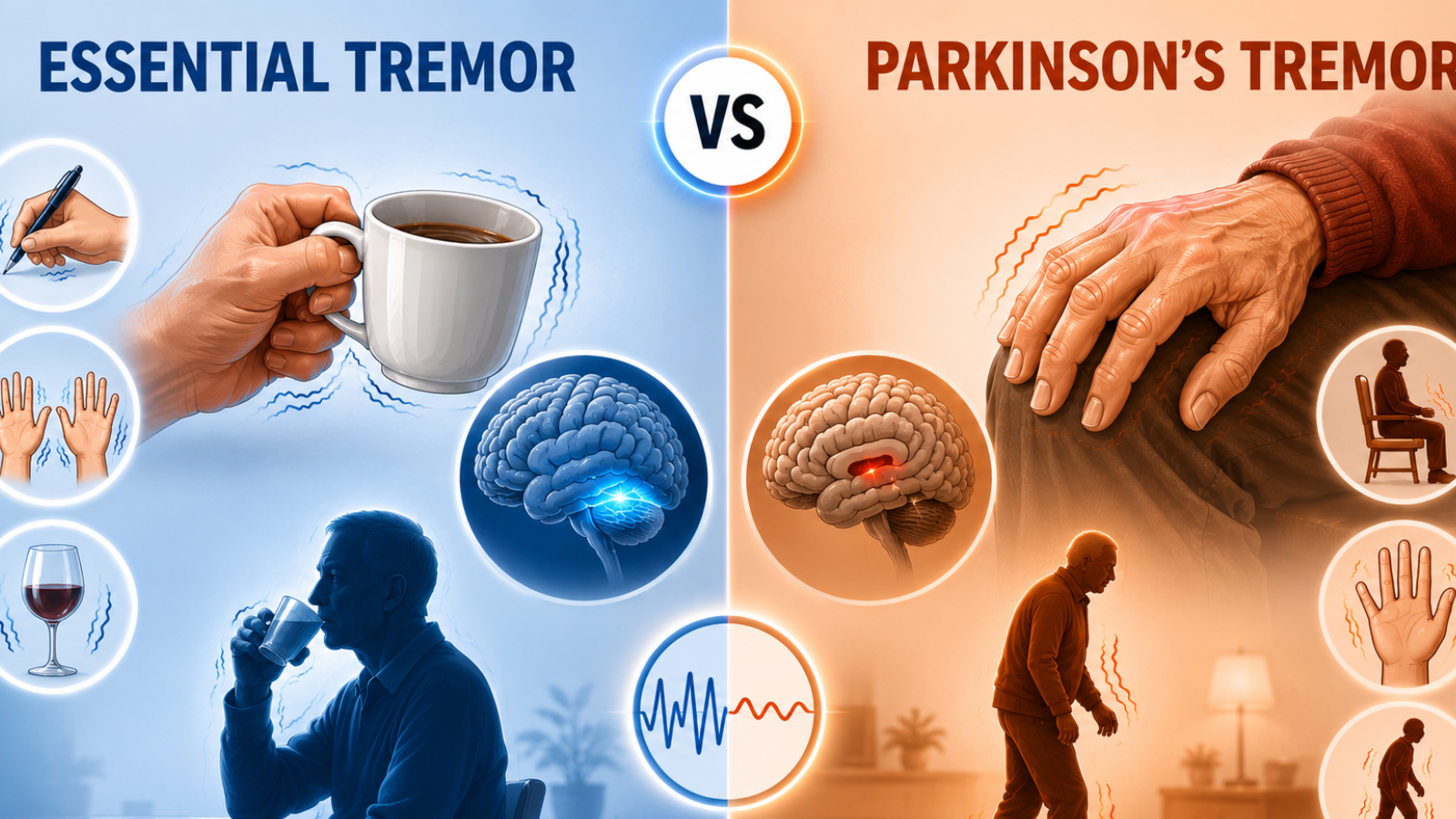
Written by Dr. Chakradhar Reddy N, MBBS, DM Neurology — Consultant Neurologist & Parkinson's and Movement Disorder Specialist, Nerve Care Clinic, Puppalaguda, Hyderabad
A person notices their hand shaking. The family notices it too. The word 'Parkinson's' enters the conversation — because Parkinson's disease is the most widely known cause of tremor, and tremor is the most visible symptom people associate with it.
But tremor is not unique to Parkinson's disease. Essential tremor is at least eight times more common than Parkinson's disease, and it is the condition most frequently confused with it. Studies in movement disorder neurology have established that up to 30–50% of essential tremor diagnoses are initially incorrect — and the reverse is also true: patients with early Parkinson's disease are sometimes reassured that their tremor is essential tremor, delaying the correct diagnosis.
Getting this distinction right matters enormously — not just for correct medication, but because the treatments are entirely different. If deep brain stimulation is ever needed, the surgical target for essential tremor is a different nucleus in the thalamus from the target for Parkinson's disease. Operating on the wrong target produces no clinical benefit and exposes the patient to surgical risk for nothing.
As a movement disorder specialist, this distinction is one of the most important assessments I make. Here is how I make it.
The Single Most Reliable Differentiator: When Does the Tremor Occur?
The most diagnostically useful question is not where the tremor is or how fast it oscillates. It is when it occurs in relation to movement.
Parkinson's tremor: rest tremor
The classic tremor of Parkinson's disease is a rest tremor — it appears when the affected limb is completely relaxed and supported, not being used for any purposeful movement. A patient sitting with their hand resting in their lap will show the tremor. When they reach out to pick up a cup, the tremor diminishes or disappears — because active motor engagement suppresses it. This disappearance with movement is a key clinical feature.
The character of Parkinson's rest tremor is described as 'pill-rolling' — the thumb moves against the fingers in a way that resembles rolling a small object. The frequency is 3–5 Hz (cycles per second). It almost always begins unilaterally — on one side only — and the asymmetry persists for years, even as the condition progresses.
Essential tremor: action tremor
Essential tremor is an action tremor — it appears during voluntary movement or when holding a posture against gravity. It is most obvious when the person is trying to use their hand: holding a cup of tea, eating with a spoon, writing, threading a needle. When the hand is fully at rest, essential tremor reduces or disappears.
Essential tremor frequency is higher than Parkinson's — typically 6–12 Hz. It almost always affects both hands (bilateral from the start), though one side may be more prominent. It can also involve the head (causing 'yes-yes' or 'no-no' movements), the voice (causing vocal tremor or shakiness when speaking), and occasionally the legs or trunk.
The Associated Features That Clinch the Distinction
Tremor character alone is not always sufficient — some patients have overlapping features, and tremor assessment requires a trained clinical eye. The associated features of each condition provide critical additional information.
Associated features of Parkinson's disease
- Bradykinesia — slowness of movement. The examiner sees reduced arm swing when walking, slowness of repetitive hand movements (tapping the thumb and index finger), and reduced facial expression (hypomimia)
- Rigidity — muscle stiffness that the neurologist feels as resistance when passively moving the patient's wrist or elbow. Patients describe it as aching, stiffness, or feeling 'wooden'
- Micrographia — handwriting becomes progressively smaller and more cramped as the patient writes a sentence or signs their name
- Shuffling gait — reduced stride length, reduced arm swing, stooped posture
- Soft voice (hypophonia)
- Non-motor features — constipation, loss of smell, mood changes, sleep disturbance (see the separate blog on Parkinson's early signs)
Associated features of essential tremor
- No bradykinesia — speed and initiation of movement are normal
- No rigidity — tone is normal on examination
- Handwriting is large and tremulous, not small — tremor is visible in the writing but the size remains normal or increased
- Normal gait and posture in the early and middle stages of the disease
- Tremor of the head and voice, which is uncommon in Parkinson's disease
- Family history — essential tremor has a clear genetic component, with a dominant inheritance pattern. More than 50% of patients report an affected family member
- Alcohol responsiveness — approximately 50–70% of essential tremor patients report significant improvement in tremor after small amounts of alcohol. This is not a treatment strategy, but it is a diagnostically useful historical detail
A Practical Comparison Table
|
Feature |
Essential Tremor |
Parkinson's Tremor |
|
When tremor occurs |
During movement and posture (action tremor) |
At rest; reduces with movement (rest tremor) |
|
Frequency |
6–12 Hz |
3–5 Hz |
|
Body parts |
Both hands, head, voice, legs |
Usually one hand first; pill-rolling quality |
|
Onset side |
Bilateral from the start |
Unilateral onset — asymmetry persists |
|
Bradykinesia |
Absent — movement speed normal |
Present — slowness of repetitive movements |
|
Rigidity |
Absent — tone normal |
Present — resistance to passive movement |
|
Handwriting |
Large and tremulous |
Small and cramped (micrographia) |
|
Family history |
Very common (>50% of cases) |
Less common; occasionally familial |
|
Alcohol response |
Improves in 50–70% |
Little or no improvement |
|
Treatment |
Propranolol, primidone, DBS (Vim nucleus) |
Levodopa, dopamine agonists, DBS (STN or GPi) |
Why Misdiagnosis Happens — and What It Costs
The clinical overlap between essential tremor and early Parkinson's disease is real, particularly in patients who have a postural tremor that is a feature of both conditions. Early Parkinson's disease can be easily mistaken for essential tremor when: the tremor is mild, the bradykinesia is subtle and hasn't been looked for carefully, and there is no family history prompting consideration of an alternative diagnosis.
The cost of misdiagnosis in both directions is significant. A patient incorrectly labelled as having essential tremor when they actually have Parkinson's disease misses the window for early neuroprotective strategies, is not appropriately counselled about what to expect, and does not have the correct medications started. A patient incorrectly diagnosed with Parkinson's disease when they have essential tremor is often given levodopa — which may temporarily improve some tremor due to placebo or nonspecific effects — reinforcing the wrong diagnosis.
The correct approach when tremor is uncertain is to see a movement disorder neurologist specifically — a neurologist who has seen enough of both conditions to be confident in the clinical distinction. This is the primary clinical reason movement disorder neurology exists as a subspecialty.
What to Expect at a Movement Disorder Consultation
At Nerve Care Clinic, when I see a patient with tremor, the assessment includes: a detailed history of when the tremor started, which tasks make it worse, whether there is a family history, whether alcohol affects it; a full neurological examination including assessment of tone, speed of repetitive movements, gait, posture, and facial expression; and often a handwriting sample. In some cases, DaTSCAN brain imaging is helpful — this nuclear medicine scan shows dopaminergic activity and can differentiate dopaminergic deficiency (Parkinson's) from normal dopamine activity (essential tremor). However, the diagnosis is primarily clinical, and most cases can be distinguished without imaging.
Book a consultation at Nerve Care Clinic, Puppalaguda — call or WhatsApp +91 9380344310. Evening OPD Monday to Saturday, 6:00 PM to 9:00 PM.
Frequently Asked Questions
1. Can essential tremor turn into Parkinson's disease?
A: The relationship is debated. Some studies suggest that people with essential tremor have a modestly increased risk of developing Parkinson's disease compared to the general population. However, essential tremor does not 'become' Parkinson's — they are distinct conditions. The overlap in some cases may reflect co-occurrence or diagnostic imprecision rather than one condition transforming into the other.
2. Can a tremor be caused by medication?
A: Yes. Drug-induced tremor is an important cause. Common culprits include lithium, valproate, certain antidepressants, metoclopramide, and some antipsychotics. Antipsychotics and some anti-nausea medications can cause drug-induced Parkinsonism — which includes tremor, rigidity, and bradykinesia, mimicking Parkinson's disease. A thorough medication history is essential in every tremor assessment.
3. My father's hands shake only sometimes. Is that still tremor worth investigating?
A: Intermittent tremor in the early stages of any tremor disorder is common. If the shaking is occurring in the context of movement (suggesting essential tremor) or at rest (suggesting Parkinson's), and particularly if other features are present — reduced arm swing, quieter voice, constipation, handwriting changes — an assessment is warranted. Waiting for the tremor to become constant delays diagnosis without benefit.
4. Is essential tremor a serious condition?
A: Essential tremor is not life-threatening, but it is progressive in most patients. As tremor amplitude increases, fine motor tasks — writing, eating, drinking without spilling — become increasingly difficult. In some patients, tremor becomes severely disabling. Both medication and, in advanced cases, deep brain stimulation can provide significant functional improvement.