 +91 9380344310
 nervecareofficial@gmail.com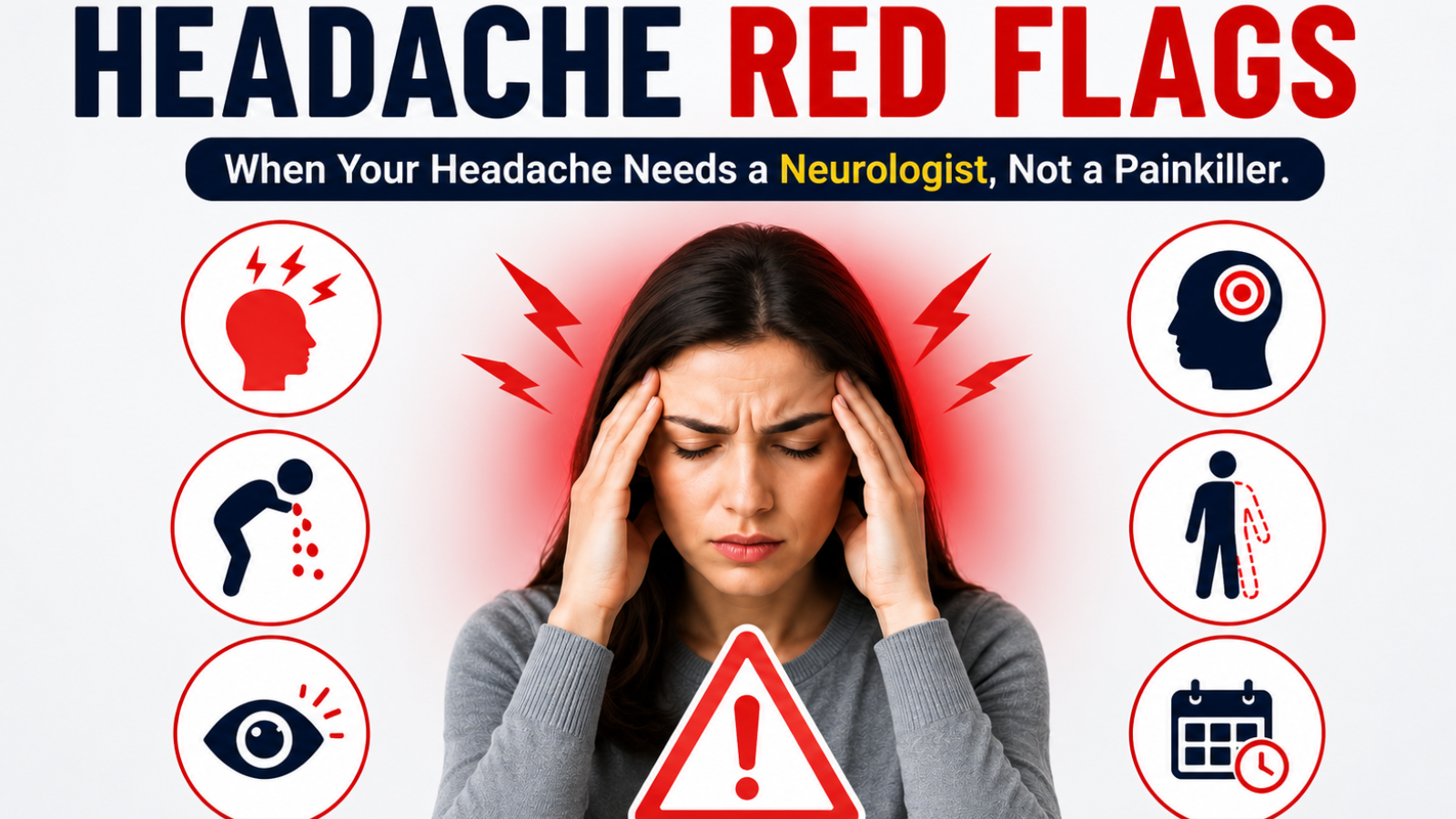
Written by Dr. Chakradhar Reddy N, MBBS, DM Neurology — Consultant Neurologist & Parkinson's and Movement Disorder Specialist, Nerve Care Clinic, Puppalaguda, Hyderabad
The vast majority of headaches even severe ones are benign. Tension-type headache, migraine, and cluster headache together account for more than 95% of all headache presentations. They are not dangerous, though they can be disabling.
A small but critical proportion of headaches are caused by serious underlying conditions — bleeding in or around the brain, infection of the brain or meninges, raised intracranial pressure, a brain tumour, arterial dissection, or a giant cell arteritis. These conditions are far less common, but missing them has consequences that range from permanent disability to death.
The challenge for both patients and general practitioners is telling them apart quickly. Neurology has developed a framework of 'headache red flags' — specific features that, when present, indicate the headache is likely secondary to a serious cause and requires urgent investigation rather than symptomatic treatment. Understanding these red flags is the most important headache knowledge any adult can have.
The SNOOP4 Red Flag Framework
Neurologists use the mnemonic SNOOP4 to remember the principal headache red flags. Each letter represents a feature that should prompt urgent evaluation:
S — Systemic symptoms
Headache accompanied by fever, night sweats, weight loss, or a stiff neck suggests infection (meningitis or encephalitis) or systemic illness affecting the brain. Bacterial meningitis — where the bacteria infect the membranes around the brain — presents with headache, fever, neck stiffness (the patient cannot touch their chin to their chest), and often a rash. This is a life-threatening emergency requiring same-day hospital care.
N — Neurological deficit
Any new headache accompanied by focal neurological symptoms — weakness or numbness in one limb, facial asymmetry, visual loss in one eye or one visual field, speech difficulty, incoordination, or altered consciousness — requires urgent assessment. This combination can indicate stroke, brain tumour, or other structural pathology. It cannot be explained by migraine alone (though migraine aura causes transient neurological symptoms — see the migraine blog — these must be distinguished from persistent or worsening deficits).
O — Onset sudden
The single most important red flag. A headache that reaches maximum intensity within seconds — described by patients as 'the worst headache of my life', 'like something exploded in my head', or 'a thunderclap' — is a subarachnoid haemorrhage until proven otherwise. Subarachnoid haemorrhage is caused by bleeding into the space around the brain, most commonly from a ruptured aneurysm. It kills or permanently disables a significant proportion of patients who reach hospital after hours of delay. The thunderclap headache is an emergency. It does not need to be associated with any other symptom to warrant immediate hospital attendance.
O — Older age, new headache
A first headache, or a significant change in headache pattern, in someone over 50 years old requires investigation. New headache in this age group raises concern for giant cell arteritis (temporal arteritis) — an inflammatory condition affecting blood vessels that can cause sudden blindness if untreated — as well as brain tumour and cerebrovascular disease.
P — Pattern change
A long-standing headache that has been stable and is now changing in character, frequency, or severity deserves assessment. A migraine sufferer whose migraines have always been manageable and predictable, but who now has a different type of headache that is worsening, should not assume the change is still just migraine. Secondary headaches can co-exist with primary headaches.
P — Postural change
A headache that significantly worsens when standing and improves when lying down suggests low cerebrospinal fluid (CSF) pressure — often after a lumbar puncture or spontaneous CSF leak. A headache that worsens when lying down or in the morning (and improves through the day) and is associated with nausea suggests raised intracranial pressure — as can occur with a space-occupying lesion or idiopathic intracranial hypertension.
P — Precipitated by Valsalva
Headache that starts or significantly worsens with coughing, sneezing, straining, or exercise suggests raised intracranial pressure or a structural abnormality such as an Arnold-Chiari malformation (where the base of the brain herniates through the base of the skull). Cough headache should always be evaluated with imaging.
P — Progressive headache
A headache that is steadily worsening over days or weeks, without a clear episodic pattern, requires investigation. This pattern can indicate a slowly expanding space-occupying lesion, subdural haematoma (a collection of blood between the brain and skull, which can develop slowly after a head injury — even a minor one in the elderly), or cerebral venous sinus thrombosis.
ℹ To summarise the situations requiring same-day emergency assessment — not a GP the next morning, not the evening clinic: thunderclap headache (maximum severity within seconds), headache with fever and neck stiffness, headache with new neurological symptoms (weakness, speech difficulty, visual loss), headache in someone who is immunocompromised or has known cancer.
Other Features That Prompt Neurological Referral
Beyond the emergency presentations above, several headache features warrant non-urgent but timely neurological assessment:
- Headache that is occurring on 15 or more days per month — this is chronic daily headache and is often associated with medication overuse that needs expert management
- Headache that has not responded to two or more adequate trials of medication, including a triptan for suspected migraine
- Headache with visual symptoms that are prolonged or not fitting a typical aura pattern
- Headache in someone on anticoagulants or with a bleeding disorder
- Headache in a pregnant woman — new headache in pregnancy is investigated differently
- Headache following a head injury, even a mild one — post-concussion headache requires different management
What a Neurological Headache Assessment Involves
At Nerve Care Clinic, a headache assessment begins with a detailed clinical history — when the headache started, how it comes on, where it is, what makes it worse and better, associated symptoms, and a medication history. The neurological examination assesses for any focal signs. Depending on the headache type and the features elicited, investigations may include an MRI brain (with or without contrast), MRA (magnetic resonance angiography) to image blood vessels, a lumbar puncture (where subarachnoid haemorrhage is suspected and CT is normal), or blood tests.
Most patients with headache presenting to the clinic have benign primary headache disorders. The value of the assessment is both in confirming the diagnosis and ruling out something that isn't benign — and giving patients the confidence to manage their headache with the correct treatment rather than over-the-counter medications that are often inadequate.
Book a consultation at Nerve Care Clinic, Puppalaguda — call or WhatsApp +91 9380344310. Evening OPD Monday to Saturday, 6:00 PM to 9:00 PM.
Frequently Asked Questions
1. What is the difference between a thunderclap headache and a severe migraine?
The key differentiator is onset speed. A thunderclap headache reaches maximum intensity within seconds — like a sudden explosion. Migraine builds over minutes to hours. A headache that reaches its worst severity within a few seconds, even if it subsequently improves, must be assessed as a possible subarachnoid haemorrhage regardless of subsequent resolution.
2. My headache is behind one eye and very severe. Is that a red flag?
Severe unilateral headache around the eye can be a cluster headache — a primary headache disorder with characteristic severe unilateral periorbital pain, occurring in clusters of attacks over weeks. This is not an emergency but does require neurological assessment and specific treatment (cluster headache does not respond to regular migraine medications). If the headache behind the eye is accompanied by a drooping eyelid, pupil asymmetry, or any visual change, seek urgent care.
3. I've had headaches for years — can they suddenly become dangerous?
A stable, long-standing headache pattern that has not changed for years is unlikely to be dangerous. What changes risk is a change in the pattern — headaches becoming more frequent, more severe, with new features, or not responding to treatments that previously worked. Any significant change in an established headache pattern warrants neurological review.
4. Can high blood pressure cause headache?
Mild to moderate hypertension does not usually cause headache despite the popular belief. However, severely elevated blood pressure (hypertensive urgency or emergency) can cause headache as part of a hypertensive crisis. If someone has a headache and is found to have markedly elevated blood pressure (above 180/120 mmHg), this requires same-day medical assessment.