 +91 9380344310
 nervecareofficial@gmail.com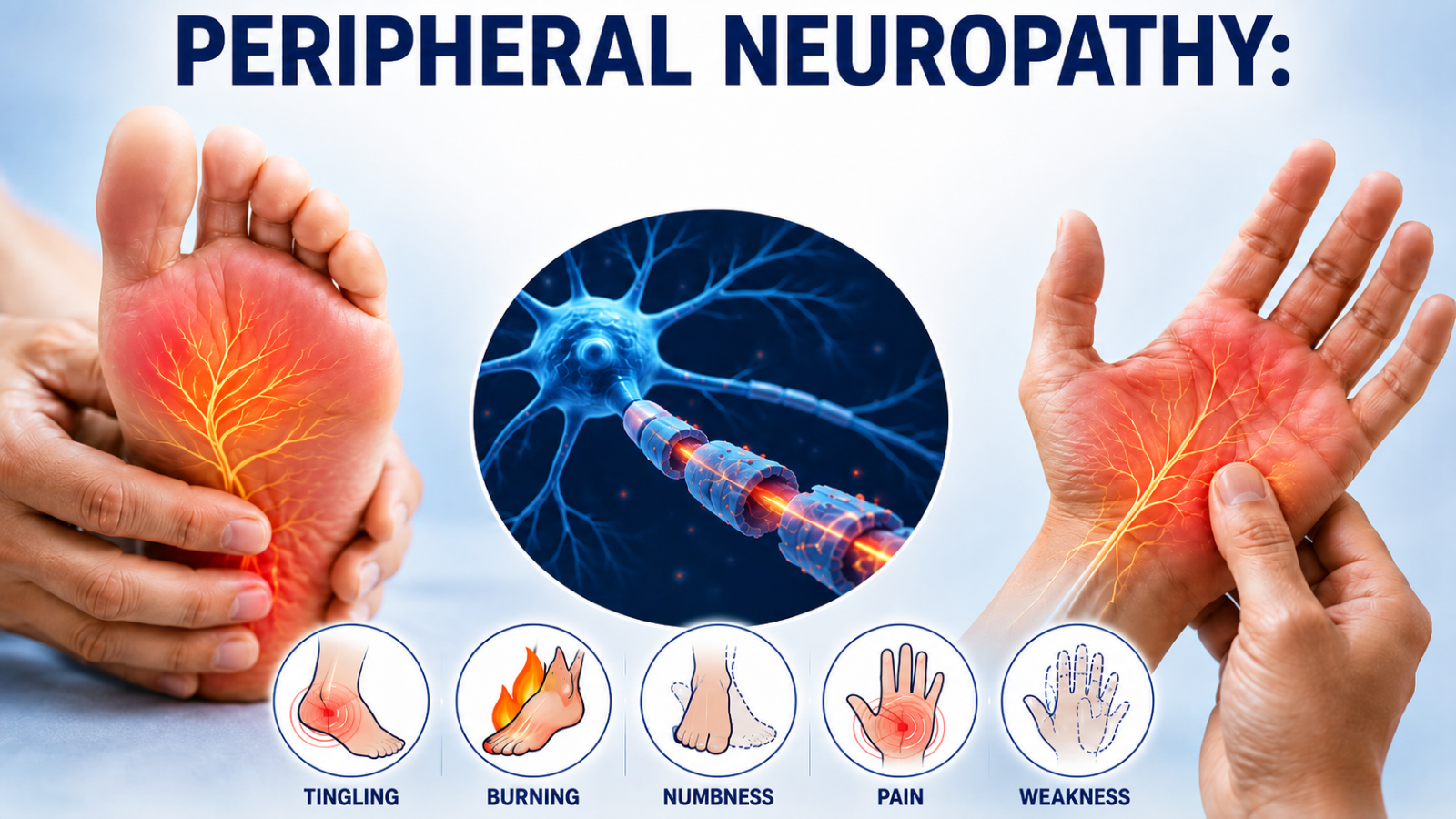
Written by Dr. Chakradhar Reddy N, MBBS, DM Neurology — Consultant Neurologist & Parkinson's and Movement Disorder Specialist, Nerve Care Clinic, Puppalaguda, Hyderabad
A tingling sensation in the feet. A burning pain in the soles that is worse at night. A feeling that your feet are wrapped in cotton wool, or that you're walking on pebbles when the floor is flat. Pins and needles in the fingers after relatively little use. Occasional electric-shock-like pains shooting down the leg.
These are the descriptions that patients use when they first come to Nerve Care Clinic with peripheral neuropathy — and they are almost universally told themselves that it is tiredness, poor circulation, or 'just ageing' before they reach a neurologist. The delay is understandable. The symptoms start subtly, are more noticeable at rest than during activity, and don't have the dramatic presentation that sends people to a doctor urgently.
But peripheral neuropathy is not benign in its consequences. Left unidentified and unaddressed, it progresses — sensory loss becomes profound, balance deteriorates, falls become frequent, and in diabetic neuropathy, the inability to feel foot injuries leads to ulceration and in severe cases amputation. The right time to see a neurologist is when the symptoms are mild, not when they are advanced.
What Is the Peripheral Nervous System?
The nervous system has two divisions. The central nervous system — the brain and spinal cord. The peripheral nervous system — the vast network of nerves that carry signals between the central nervous system and every other part of the body.
Peripheral nerves have three functional types: sensory nerves carry information from the skin and body (touch, temperature, pain, position) to the brain; motor nerves carry movement commands from the brain to the muscles; autonomic nerves control involuntary functions — heart rate, blood pressure, sweating, digestion, bladder function.
Peripheral neuropathy is damage to one or more peripheral nerves, disrupting their ability to transmit these signals. The pattern of symptoms — which nerves are affected, whether predominantly sensory or motor or autonomic, whether symmetrical or asymmetrical — guides the diagnosis of the underlying cause.
What Peripheral Neuropathy Feels Like — The Symptom Patterns
Length-dependent sensory neuropathy (the most common pattern)
The most frequent form begins in the longest nerves first — which is why symptoms start in the feet, then work upward toward the knees, and eventually may involve the hands. This pattern, called a 'stocking and glove' distribution, reflects the principle that longer nerve fibres are most vulnerable to metabolic or toxic damage. Symptoms include burning pain (worst at night when there are no competing sensory inputs), tingling or pins and needles, numbness that reduces the ability to feel the floor, and heightened sensitivity where light touch feels unpleasant.
Small fibre neuropathy
This affects only the small, unmyelinated pain and temperature fibres. Standard nerve conduction studies can be normal — because they measure large fibre function. Small fibre neuropathy causes burning pain, temperature dysregulation, and autonomic symptoms (excessive sweating or lack of it, lightheadedness on standing). Skin biopsy measuring intraepidermal nerve fibre density is the definitive test.
Motor neuropathy
When motor fibres are predominantly affected, the pattern shifts to weakness and wasting of muscles — particularly the small muscles of the feet (causing foot drop, difficulty walking on heels) and the hands (difficulty gripping, opening jars). Motor neuropathy causes less pain than sensory neuropathy but more functional disability.
Autonomic neuropathy
Damage to autonomic fibres causes dizziness on standing (postural hypotension), abnormal heart rate responses, sweating abnormalities, constipation or diarrhoea, impotence, and bladder dysfunction. Autonomic neuropathy is particularly common in longstanding diabetes and can be life-affecting even when sensory and motor symptoms are mild.
The Most Common Causes in India — and Why Identifying the Cause Matters
Peripheral neuropathy is a symptom of many different diseases. Identifying the cause is the most important step — because some causes are completely reversible if identified early, while others require long-term management. In Indian clinical practice, the most common causes I encounter are:
Diabetes — the leading cause
Diabetic peripheral neuropathy affects approximately 50% of people with longstanding diabetes. It typically follows the length-dependent pattern — feet first. Crucially, neuropathy can be the presenting symptom of previously undiagnosed Type 2 diabetes, or may develop in patients whose blood sugar has been poorly controlled. It is largely preventable and can be arrested with optimal glycaemic control, but once established, reversal is limited. Every patient with neuropathy gets fasting blood sugar and HbA1c measured.
Vitamin B12 deficiency
B12 deficiency neuropathy is particularly common in vegetarians and those on prolonged metformin therapy (metformin reduces B12 absorption). It is entirely and rapidly reversible with B12 supplementation if identified early, and a major cause of preventable neuropathy in India. A serum B12 level below 200 pg/mL is concerning; below 150 pg/mL is diagnostic. Symptoms include tingling in the hands and feet, weakness, and in severe cases, spinal cord involvement (subacute combined degeneration).
Alcohol-related neuropathy
Chronic heavy alcohol use causes a predominantly sensory and painful neuropathy. The mechanism involves both direct toxicity and nutritional deficiency (thiamine, B12). Abstinence and nutritional support are the primary treatments.
Inflammatory and autoimmune neuropathies
Guillain-Barré Syndrome (GBS) — an acute ascending paralysis that begins in the feet and moves upward — is a medical emergency. CIDP (Chronic Inflammatory Demyelinating Polyneuropathy) is a slower-progressing but treatable autoimmune neuropathy that responds well to immunotherapy. Vasculitic neuropathy, where inflamed blood vessels damage nerves, often presents asymmetrically and requires specific treatment.
Thyroid disease, kidney disease, medications
Hypothyroidism causes a mild symmetrical neuropathy that reverses with thyroid hormone replacement. Chronic kidney disease causes uraemic neuropathy. Several medications — particularly chemotherapy agents (vincristine, taxanes, platinum compounds), isoniazid for tuberculosis, and some antibiotics — are neurotoxic.
How Peripheral Neuropathy Is Investigated
The investigation of neuropathy begins with blood tests: fasting glucose, HbA1c, B12 and folate, thyroid function, kidney and liver function, full blood count, and in selected cases SPEP (serum protein electrophoresis for paraproteins) and specific inflammatory markers.
The primary electrophysiological test is nerve conduction study (NCS) combined with electromyography (EMG). NCS measures the speed and amplitude of electrical signals travelling through specific nerves — it distinguishes demyelinating from axonal neuropathy, localises the problem, and quantifies the severity. EMG measures electrical activity in muscles and identifies whether weakness has a nerve or muscle origin.
NCS/EMG is done at the Nerve Care Clinic. The test takes approximately 45–60 minutes depending on the number of nerves studied, is not painful (though it involves mild electrical pulses and needle EMG), and provides objective data that guides treatment decisions.
Treatment — What Is Actually Available
Treatment of peripheral neuropathy operates on two levels. Treating the underlying cause (if one is found and reversible — B12 supplementation, optimal glycaemic control, thyroid replacement, stopping the offending medication, immunotherapy for CIDP) is the primary aim. Symptom management for neuropathic pain — the burning, shooting, electric-shock pain — uses specific neuropathic pain medications: gabapentin, pregabalin, duloxetine, and tricyclic antidepressants (amitriptyline) are the most evidence-based options. Standard painkillers (paracetamol, NSAIDs) are largely ineffective for neuropathic pain.
Book a consultation at Nerve Care Clinic, Puppalaguda — call or WhatsApp +91 9380344310. Evening OPD Monday to Saturday, 6:00 PM to 9:00 PM.
Frequently Asked Questions
1. Can neuropathy be cured?
This depends entirely on the cause. B12 deficiency neuropathy is completely reversible. Inflammatory neuropathies (GBS, CIDP) can recover substantially with appropriate treatment. Diabetic neuropathy can be halted with optimal blood sugar control but rarely fully reverses. Chemotherapy-induced neuropathy sometimes improves after the drug is stopped. Hereditary neuropathies are not reversible but can be managed. The cause determines the prognosis.
2. Why is neuropathy pain worse at night?
During the day, competing sensory inputs — touch, pressure, movement — partially mask neuropathic sensations. At night, in a quiet bed with no competing input, the abnormal nerve signals become the dominant sensory experience. This diurnal pattern is characteristic of neuropathic pain and is useful diagnostically.
3. Is tingling in the hands always neuropathy?
Not always. Carpal tunnel syndrome — compression of the median nerve at the wrist — is a very common cause of tingling and numbness in the thumb, index, middle, and part of the ring finger. Cervical radiculopathy (nerve root compression in the neck) causes arm and hand tingling in specific nerve root distributions. A neurologist distinguishes between peripheral neuropathy, focal nerve entrapment, and radiculopathy through examination and NCS/EMG.
4. How long does it take to see improvement with treatment?
This depends on the cause and the severity of damage. B12 supplementation can improve symptoms within weeks. Diabetic neuropathy improvement with glycaemic control occurs over months. Neuropathic pain medications typically take 4–8 weeks to reach optimal effect at the right dose. Patience and regular follow-up are essential — neuropathy treatment timelines are measured in months, not days.