 +91 9380344310
 nervecareofficial@gmail.com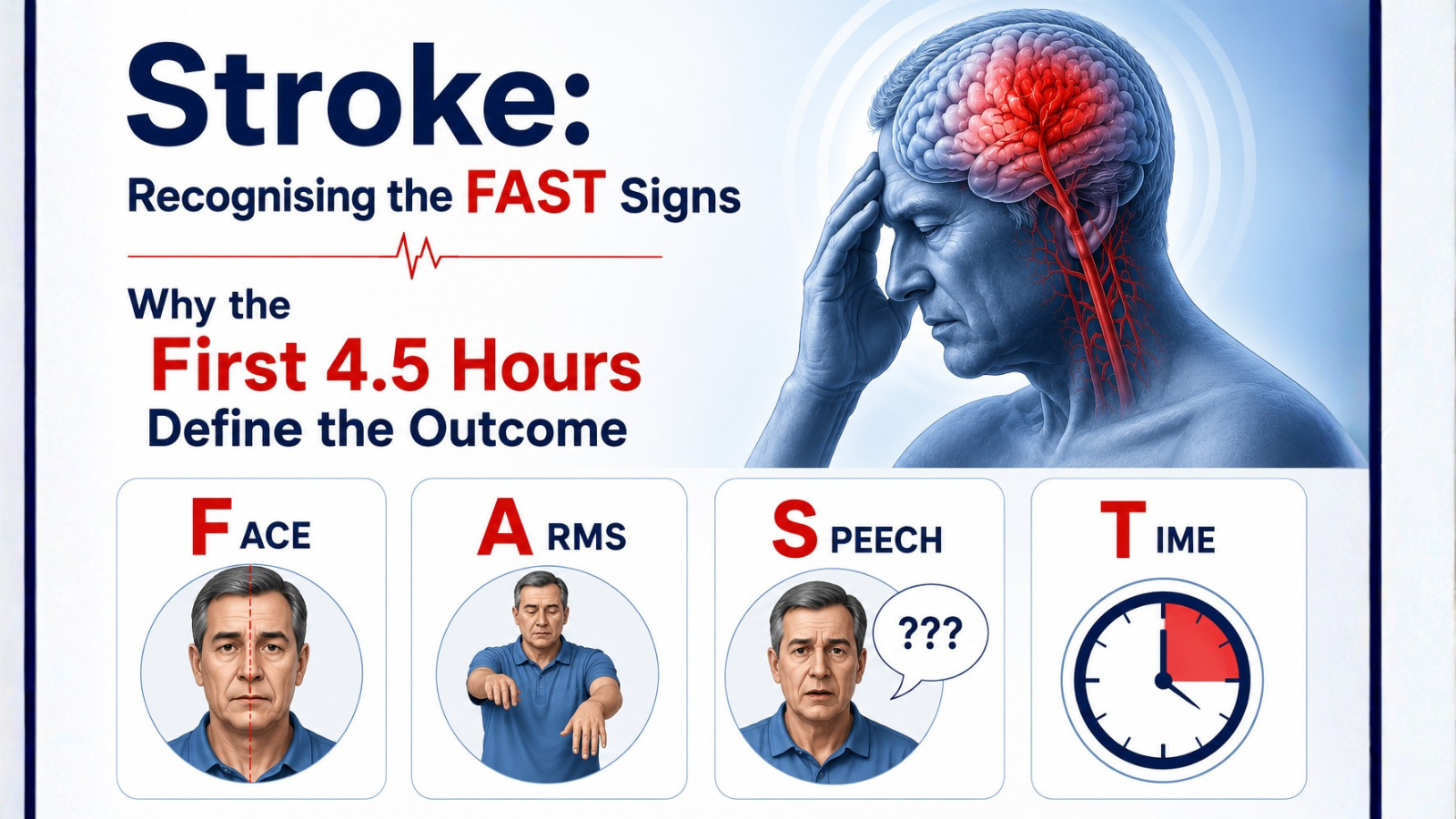
Written by Dr. Chakradhar Reddy N, MBBS, DM Neurology — Consultant Neurologist & Parkinson's and Movement Disorder Specialist, Nerve Care Clinic, Puppalaguda, Hyderabad
Every minute during a major ischemic stroke, approximately 1.9 million neurons are lost. Every hour without treatment ages the brain roughly 3.6 years. Stroke is the second leading cause of death worldwide and the leading cause of adult disability — and the single most important variable determining whether a person survives it with function intact is how quickly they receive treatment after symptoms begin.
Unlike almost every other serious medical condition, stroke has a hard time boundary. Not a guideline, not a preference — a boundary. The primary treatment for ischemic stroke, intravenous thrombolysis, is effective up to 4.5 hours from symptom onset. After that window closes, the clot-dissolving treatment that can restore blood flow cannot be safely administered. And every minute within that window matters: patients treated in the first 90 minutes have dramatically better outcomes than those treated at 3 hours, who do significantly better than those treated at 4 hours.
Most stroke deaths and disabilities in India are preventable — not because better treatments don't exist, but because patients or families do not recognise what is happening quickly enough to act in time. This blog explains what to recognise, what to do, and why time is the treatment.
What Is a Stroke?
A stroke occurs when blood supply to part of the brain is suddenly interrupted. There are two types:
Ischemic stroke (87% of all strokes)
A blood clot blocks an artery supplying the brain, cutting off oxygen and glucose to the downstream brain tissue. Without blood flow, brain cells die rapidly. Ischemic stroke is the type where thrombolysis (clot-busting medication) and mechanical thrombectomy (physically removing the clot with a catheter) are the primary interventions — and both are time-critical.
Haemorrhagic stroke (13% of all strokes)
A blood vessel in or around the brain ruptures, causing bleeding into or around brain tissue. Treatment is different — the priority is controlling bleeding and reducing pressure, not dissolving a clot. Haemorrhagic stroke is equally urgent but treated differently, which is why imaging (CT scan) is done immediately to distinguish the two types before any treatment is given.
The FAST Signs — What Every Adult Must Know
FAST is the internationally recognised acronym for stroke recognition. It covers the four most common and most reliably recognisable signs of stroke:
F — FACE: Ask the person to smile. Does one side of the face droop? Does the smile look uneven or the mouth pull to one side?
A — ARM: Ask the person to raise both arms. Does one arm drift downward? Can they hold both up at the same height?
S — SPEECH: Ask the person to say a simple sentence. Is their speech slurred, garbled, or strange? Can they understand what you're saying?
T — TIME: If you see ANY of the above — call for emergency help immediately. Note the exact time symptoms started.
FAST captures the most common stroke presentations — those involving the middle cerebral artery, which supplies the face, arm, and speech areas. Other stroke symptoms that FAST does not fully capture include:
- Sudden severe headache — described as 'the worst headache of my life', coming on like a thunderclap — this is the hallmark of subarachnoid haemorrhage and requires immediate emergency care
- Sudden vision loss or double vision — particularly in one eye or half the visual field
- Sudden vertigo or loss of balance — particularly with difficulty walking, falling to one side, or vomiting (posterior circulation stroke)
- Sudden confusion or altered consciousness
- Sudden numbness or weakness in one leg
⚠ Any sudden neurological symptom — facial drooping, arm weakness, speech difficulty, vision loss, severe headache, sudden loss of balance — that appears abruptly and is new, must be treated as stroke until proven otherwise. Do not wait to see if it improves. Do not drive the patient to a clinic. Call 108 (emergency services) or take them directly to the emergency department of the nearest hospital with a CT scanner and a neurology team.
Why 4.5 Hours — The Science Behind the Window
Intravenous tissue plasminogen activator (IV tPA, also called rt-PA) is a clot-dissolving medication given through a drip. It breaks down the fibrin in blood clots, restoring blood flow to ischemic brain tissue. The 2026 AHA/ASA guidelines affirm that IV tPA administered within 4.5 hours of symptom onset is the standard of care for ischemic stroke in eligible patients.
The relationship between time and outcome is not linear — it is exponential. Patients treated within 90 minutes do dramatically better than those treated at 3 hours. Those treated at 3 hours do substantially better than those treated at 4 hours. The term 'golden hour' in stroke refers specifically to the period where gains are most decisive. Every 15 minutes saved in getting to treatment translates to measurably better recovery.
Beyond 4.5 hours, mechanical thrombectomy — a catheter-based procedure that physically retrieves the clot — can be performed in carefully selected patients up to 24 hours after symptom onset in hospitals with interventional capabilities. This extended window applies to specific patients with large vessel occlusions and evidence of salvageable brain tissue on imaging. It is an important advance but does not change the principle: earlier is always better.
The Most Common Reason Strokes Are Treated Late in India
In most Indian stroke cases that present outside the treatment window, the delay is not in transport or hospital capacity. It is in recognition. The family does not realise what is happening. They think the person is having a 'brain attack' that will resolve on its own. They wait to see if the weakness or speech difficulty improves. They drive to the family doctor first. They call relatives before calling for emergency help. Every minute of that waiting is neurons dying.
The other common delay: stroke at night. The patient goes to sleep apparently well, and the family notices the weakness or slurred speech only when they wake — by which point the time of onset cannot be established, and the treatment window is calculated from the last time the patient was known to be normal. Patients who wake with stroke symptoms are treated as if their symptoms started at the last time they were seen well.
Stroke Prevention — What a Neurologist Does Between Strokes
Approximately 25–35% of people who have one stroke will have another within 5 years without adequate secondary prevention. The neurologist's role in stroke is not only acute management but long-term risk reduction:
- Identifying the cause of the stroke — cardioembolic (from the heart), large artery atherosclerotic, small vessel, or cryptogenic — because the prevention strategy differs
- Starting or optimising antiplatelet therapy (aspirin, clopidogrel) or anticoagulation (for atrial fibrillation)
- Aggressive blood pressure management — hypertension is the single most modifiable stroke risk factor
- Statin therapy for cholesterol management
- Lifestyle modification — smoking cessation, diabetes control, reducing excess alcohol
- Carotid imaging — if significant carotid stenosis is found, surgical or endovascular intervention may be indicated
For patients who have had a TIA (transient ischaemic attack — a 'mini-stroke' where symptoms resolve within 24 hours), the risk of a full stroke in the following days is high and should be treated with the same urgency as a full stroke.
Book a consultation at Nerve Care Clinic, Puppalaguda — call or WhatsApp +91 9380344310. Evening OPD Monday to Saturday, 6:00 PM to 9:00 PM.
Frequently Asked Questions
1. Can stroke symptoms improve on their own?
A: Symptoms may temporarily improve — this does not mean the stroke has resolved. Stroke symptoms that fluctuate or partially improve can indicate a TIA (transient ischaemic attack) or an evolving stroke. Both require emergency assessment. Do not wait for symptoms to 'fully go away' before seeking help.
2. How do I know if a hospital can treat stroke?
A: Any hospital with a CT scanner, emergency department, and a neurologist or physician available 24 hours can initiate basic stroke assessment and thrombolysis. For mechanical thrombectomy, a hospital with interventional neuroradiology or neurosurgery capability is needed. When in doubt, go to the nearest major hospital emergency — they will stabilise and transfer if needed.
3. Can young people have strokes?
A: Yes. Stroke in people under 45 is not uncommon and is more likely to have specific causes — congenital heart defects, dissection of the carotid or vertebral artery, antiphospholipid syndrome, or clotting disorders. All stroke patients, including young ones, require a full investigation for cause.
4. What does post-stroke neurological care involve?
A: Post-stroke care involves assessing the extent of neurological deficit, starting or adjusting secondary prevention medications, coordinating rehabilitation (physiotherapy, speech therapy, occupational therapy where needed), monitoring for complications, and regular follow-up to check for recovery and stroke recurrence risk factors.